

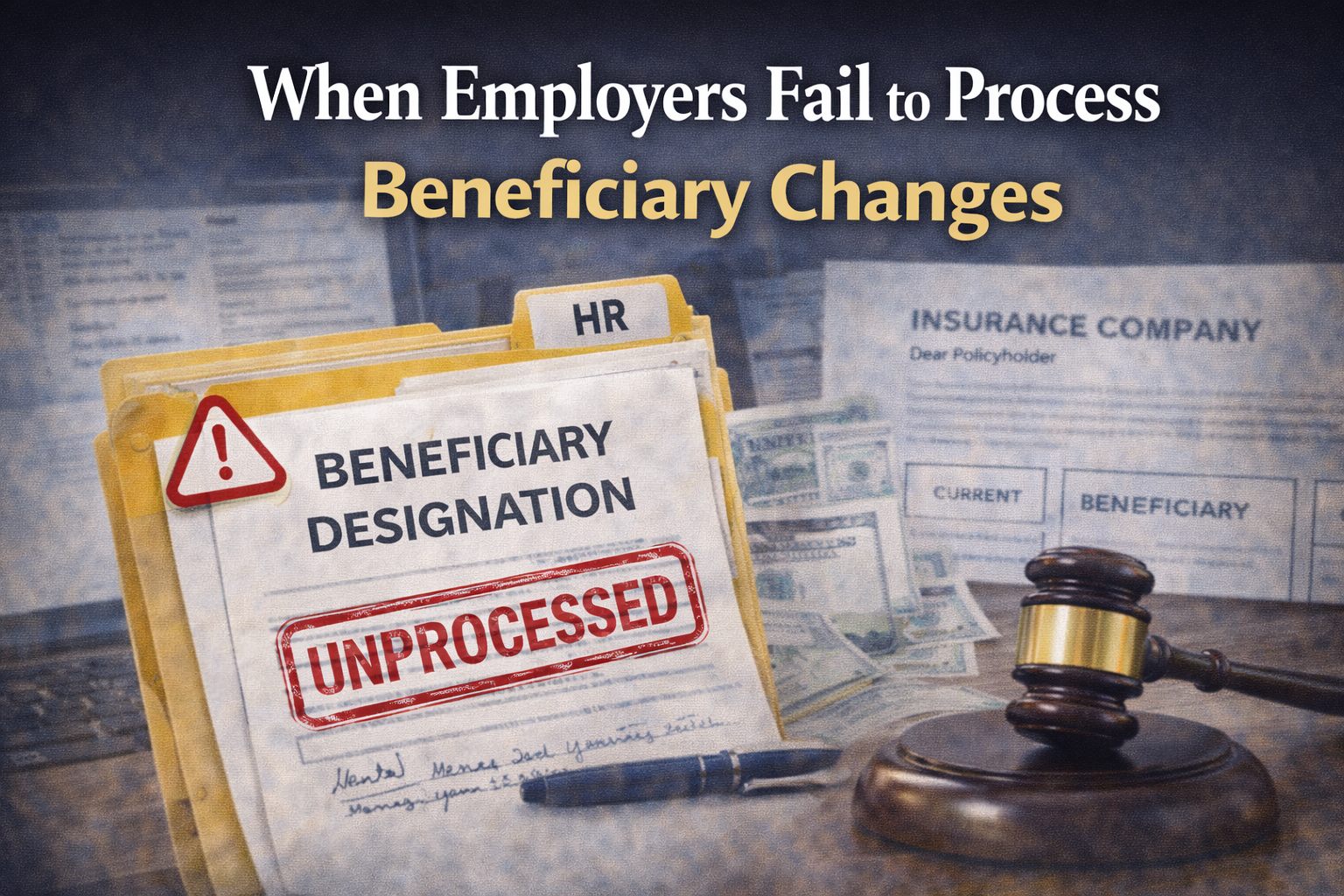
Many life insurance beneficiary disputes do not begin after death. They begin months or years earlier, when a policyholder submits a beneficiary change to their employer and assumes the update is complete. In reality, employer administrative failures are one of the most common and least visible causes of disputed life insurance payouts.
When an employer receives a beneficiary change form but never forwards it to the insurance company, the insurer’s records remain unchanged. After the insured dies, the insurer pays based on what is in its system, not what the policyholder intended. This disconnect often leads to denied claims, interpleader lawsuits, and prolonged family disputes.
Understanding how this trap occurs and how it can be challenged is critical for protecting the policyholder’s intent. When you are facing a beneficiary dispute, we are here for you. Look at our beneficiary dispute fact sheet for more information.
How the Unprocessed Change Trap Occurs
Most employees reasonably believe that submitting a beneficiary change to human resources completes the process. In employer provided life insurance, however, the employer acts as the middleman. If the employer fails to transmit the update properly, the insurer may never receive it.
Common breakdowns include HR departments receiving the form but never uploading it to the insurer portal, scanning the document without transmitting it, or using outdated forms that the insurer later rejects. In some cases, employers process the update for one policy but overlook another, such as basic life versus supplemental coverage.
When the insured dies, the insurer relies solely on its internal records. If the employer never forwarded the update, the insurer defaults to the old beneficiary.
Why Insurers Rely on the Old Beneficiary
Insurers typically take the position that only documents in their possession control beneficiary designations. If the updated form never reached the insurer, they often argue that the change was never completed.
Insurers may claim the policyholder failed to follow required procedures, that the insurer cannot verify the authenticity of the form, or that the employer is responsible for administrative failures. In ERISA governed plans, insurers often rely on the plan documents rule, which prioritizes the insurer’s records over outside evidence unless an exception applies.
This leaves the intended beneficiary facing a denial unless they can prove that the policyholder did everything reasonably required to make the change.
When Employer Errors Create Legal Liability
Courts recognize that employees rely on their employers to handle enrollment and beneficiary updates correctly. When an employer fails to process a change, liability may extend beyond the insurer.
Legal theories that commonly arise include negligence in handling plan documents, breach of fiduciary duty under ERISA, failure to follow plan procedures, or providing incorrect information to the employee. In some cases, employers become co defendants in interpleader actions or face separate claims for damages equal to the lost benefit.
Employer liability becomes especially significant when HR confirms receipt of the form but fails to act.
Substantial Compliance and the Policyholder’s Intent
Many courts apply the substantial compliance doctrine in beneficiary disputes. This doctrine allows a beneficiary change to be enforced even if technical requirements were not completed, as long as the policyholder clearly intended to make the change and took reasonable steps to do so.
Evidence supporting substantial compliance may include a completed and signed change form, emails or messages to HR confirming submission, employer records showing receipt, witness statements, or portal logs with timestamps. Consistent statements by the policyholder about their intended beneficiary can also be persuasive.
When substantial compliance is established, courts may order the insurer to pay the intended beneficiary despite the employer’s failure to transmit the form.
How Interpleader Lawsuits Enter These Cases
When the insurer faces competing claims from the old beneficiary and the intended beneficiary, it often files an interpleader action. This allows the insurer to deposit the policy proceeds with the court and avoid choosing sides.
Interpleader is common when the employer admits receiving the form but never sent it, the insurer denies receipt, and the old beneficiary refuses to relinquish the claim. While interpleader delays payment, it also provides a formal process to prove the policyholder’s intent and the employer’s administrative failure.
What Families Should Do When a Change Was Not Processed
When a beneficiary update was submitted but not processed, the intended beneficiary should gather as much documentation as possible. This includes copies of the completed form, emails or messages showing submission, HR confirmations, internal employer records, and statements from coworkers or supervisors.
Evidence showing the policyholder’s consistent intent is often critical. The goal is to demonstrate that the failure was administrative, not a change of mind.
Why This Trap Is More Common Than Most People Realize
Employer administrative errors are a leading but largely invisible cause of life insurance beneficiary disputes. Many HR departments rely on manual processes, outdated systems, or third party administrators. Employees assume updates are handled correctly, but insurers honor only what appears in their records.
The gap between employer handling and insurer systems is where many families lose benefits unless they challenge the denial. Recognizing this trap early can make the difference between a denied claim and enforcing the policyholder’s true intent.