

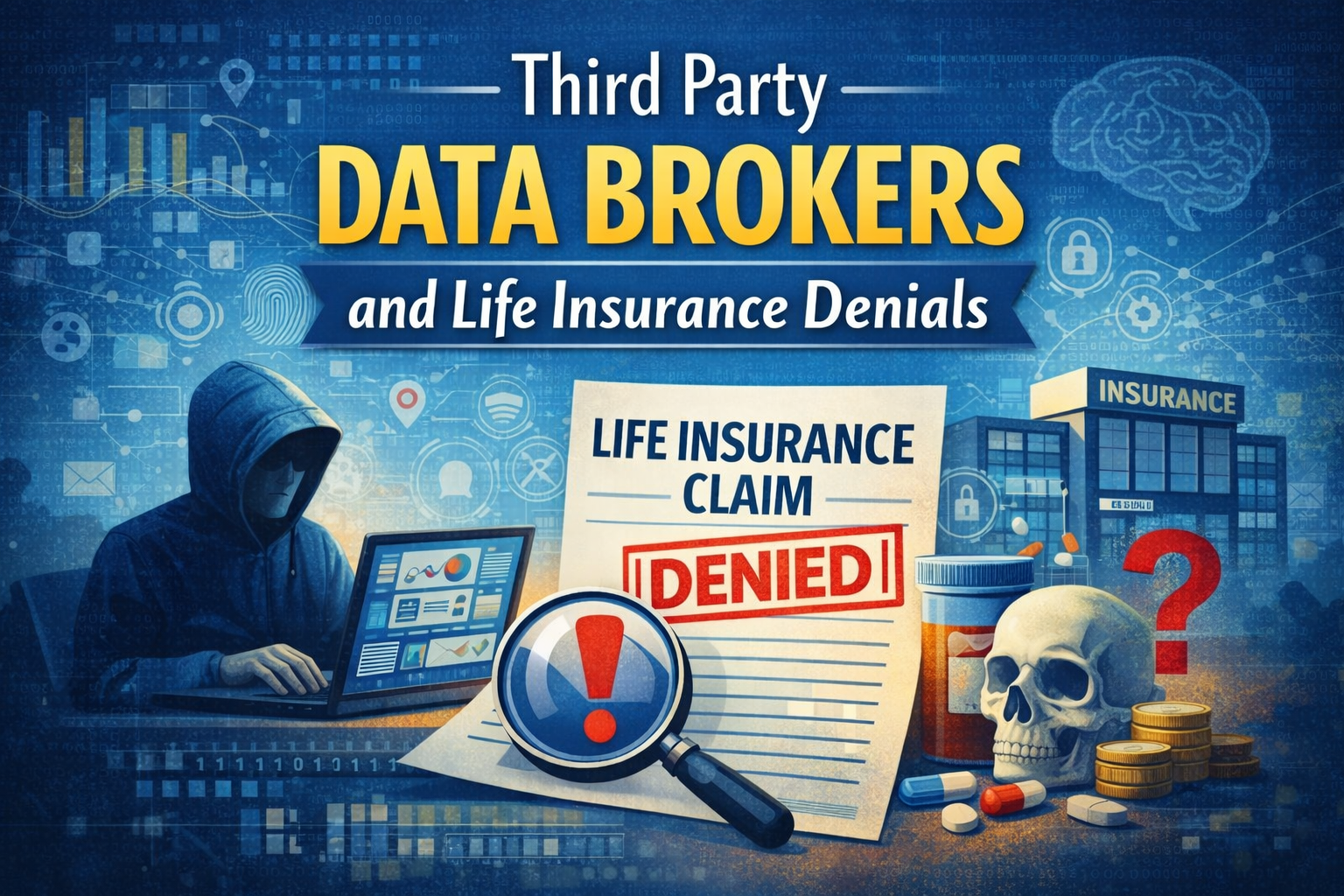
Life insurance companies are increasingly relying on third party data brokers to evaluate claims. This practice is already influencing claim investigations and denials, even though most beneficiaries have no idea it is happening.
Data brokers collect, analyze, and sell personal information at massive scale. Insurers now use this data both when issuing policies and after a claim is filed. In some cases, information obtained from a data broker becomes the foundation for a denial.
Understanding how this system works is critical for anyone facing a delayed or denied life insurance claim.
What Third Party Data Brokers Do
Data brokers aggregate personal data from thousands of sources. These sources include public records, prescription databases, credit data, consumer purchases, social media activity, location tracking, online behavior, and subscription services.
The individual whose data is being sold is rarely aware of the scope or accuracy of the information. Errors are common. Context is often missing. Yet insurers treat broker data as investigative leads or supporting evidence.
In life insurance claims, this information is frequently used to look for inconsistencies, omissions, or alleged misrepresentations.
How Insurers Use Broker Data After a Death
When a life insurance claim is filed, insurers may quietly run the insured’s name through multiple data vendors. The goal is to see whether the data tells a story that conflicts with the policy application or the cause of death.
Examples include undisclosed medications, lifestyle indicators suggesting risky behavior, travel data contradicting residency claims, or financial data used to question insurable interest.
If the broker data raises questions, the insurer may open a full investigation. Beneficiaries are rarely told that third party data triggered the review.
Common Denial Theories Based on Broker Information
Insurers often rely on data broker findings to support familiar denial arguments.
One common theory is application misrepresentation. If broker data suggests a medical condition, prescription, or habit not disclosed at policy issuance, the insurer may argue the policy should be rescinded.
Another theory involves exclusions. Data implying hazardous activities, substance use, or travel risks may be used to justify an exclusion, even when the policy language is vague.
Some insurers use broker data to delay claims while searching for a justification, rather than responding to the actual claim submitted.
The Accuracy Problem With Broker Data
Third party data is not verified the way medical records or official documents are. Much of it is inferred, outdated, or incorrectly attributed.
People are often misclassified due to name matches, shared addresses, or algorithmic assumptions. Prescription databases may show medications that were prescribed but never taken. Online behavior can be misinterpreted.
Despite these flaws, insurers may treat broker data as reliable unless challenged.
Why Beneficiaries Are at a Disadvantage
Beneficiaries usually have no access to the data being used against them. Insurers do not automatically disclose which brokers they consulted or what information was obtained.
This creates an imbalance. The insurer has secret data inputs, while the beneficiary responds to vague denial letters referencing misrepresentation or policy provisions.
Without legal pressure, insurers may never reveal the real basis for the denial.
Legal Limits on Using Third Party Data
Insurers are allowed to investigate claims, but they are not allowed to deny valid claims based on speculation, unverified data, or information unrelated to the policy terms.
State insurance laws prohibit unfair claims practices, including unreasonable delay and denial without proper investigation. A data broker report does not replace actual proof.
If the policy language does not support the denial, third party data cannot create new exclusions after the fact.
How Life Insurance Attorneys Challenge Broker Based Denials
Experienced life insurance attorneys know how to identify when broker data is driving a denial. Patterns in investigation timing, document requests, and denial language often reveal third party involvement.
Attorneys can demand disclosure of data sources, challenge the accuracy of broker information, and force insurers to tie their arguments to actual policy language.
Many broker based denials collapse once insurers are required to defend them with admissible evidence.
What Beneficiaries Should Do
If a claim is delayed or denied and the explanation feels vague or inconsistent, beneficiaries should be cautious. Providing additional information without understanding the insurer’s strategy can backfire.
Preserve all correspondence. Do not assume broker data is accurate. Do not accept partial settlements without legal review.
Most importantly, understand that data collected by third parties does not override your rights under the policy.
Final Thoughts
Life insurance denials based on third party data brokers are a growing trend. As insurers expand surveillance and data driven decision making, beneficiaries face new and largely invisible obstacles.
Awareness is the first defense. Legal advocacy is often the most effective response. When insurers rely on secret data to deny claims, transparency and accountability become essential to securing the benefits families are owed.
We have recently settled claims from: Mutual of Omaha; Globe Life; RiverSource Life (Ameriprise); and Sammons Financial (North American / Midland National).