

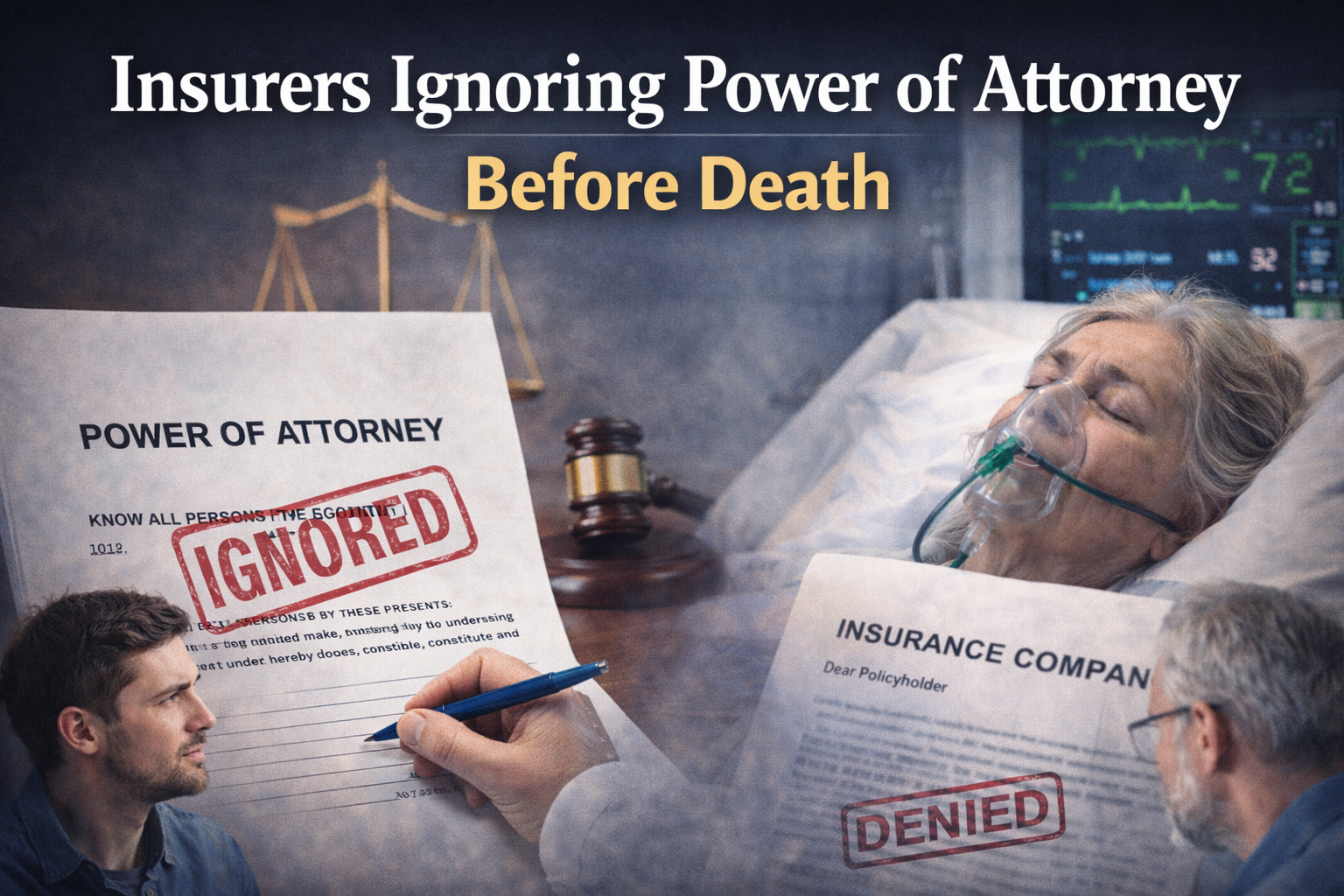
Power of Attorney documents exist to protect families when someone becomes too ill or incapacitated to manage their own affairs. In the life insurance context, a properly executed Power of Attorney allows an authorized agent to update beneficiary designations, correct administrative errors, and ensure the insured’s wishes are carried out.
Despite this, insurers frequently ignore valid Power of Attorney actions taken before death. They claim the document was never received, never processed, not recognized, or not sufficient, even when the paperwork fully complies with state law. These failures often result in denied claims, interpleader lawsuits, and benefits being paid to the wrong person.
Below are ten common situations where insurers disregard valid Power of Attorney changes and later rely on that failure to dispute or deny a life insurance claim.
1. The Insurer Claims the Power of Attorney Was Never Received
Families often submit a Power of Attorney by email, fax, upload portal, or certified mail. Insurers later insist they never received it. In many cases, the document was received but never scanned into the system or was lost during internal processing. When the insured dies, the insurer defaults to the prior beneficiary even though valid paperwork was submitted well before death.
2. The Insurer Says the Power of Attorney Was Not on Their Preferred Form
Some insurers insist that only their proprietary Power of Attorney form is acceptable. In most states, this is incorrect. A properly executed, state compliant Power of Attorney is legally valid regardless of an insurer’s internal preferences. Insurers use this excuse to disregard beneficiary changes that were fully authorized.
3. The Insurer Claims the Power of Attorney Did Not Specifically Mention Life Insurance
Many Power of Attorney documents grant broad authority over financial and contractual matters. Insurers sometimes argue that life insurance or beneficiary changes must be explicitly named. This often misstates state law. When a Power of Attorney grants authority over financial affairs, insurance contracts are commonly included. Insurers rely on this argument to avoid honoring the insured’s intent.
4. The Beneficiary Change Was Submitted but Never Processed
Even when insurers acknowledge receipt of the Power of Attorney, the beneficiary update itself may sit unprocessed, remain pending, or be routed incorrectly. If the insured dies before the insurer completes its internal steps, the insurer claims the change never took effect. This scenario frequently leads to interpleader litigation.
5. The Insurer Claims the Power of Attorney Was Not Yet Effective
For springing Powers of Attorney, insurers may argue that the insured was not incapacitated at the time of the change. They sometimes demand proof that state law does not require or ignore medical records that clearly establish incapacity. This creates unnecessary delay and allows insurers to challenge otherwise valid updates.
6. The Insurer Rejects the Power of Attorney Based on Internal Notary or Witness Rules
A Power of Attorney that satisfies state law is legally valid. Insurers sometimes impose additional requirements, such as extra witnesses or specific notarization formats, even when those standards are not required by law. This allows them to disregard beneficiary changes that were properly authorized.
7. The Insurer Claims the Agent Lacked Authority to Change Beneficiaries
Insurers sometimes argue that a Power of Attorney does not allow beneficiary changes unless that authority is explicitly stated. In many jurisdictions, general financial authority includes the ability to manage insurance contracts. Insurers often misapply these rules to avoid paying claims or to complicate payout decisions.
8. The Insurer Refuses to Honor the Power of Attorney Because the Change Was Not Made Through an Online Portal
Many online portals do not allow Power of Attorney holders to log in or make changes. When updates are submitted by email or paper, insurers may claim that only portal submissions are valid. A valid Power of Attorney overrides portal limitations. Insurers use this excuse to ignore lawful changes.
9. The Insurer Claims the Power of Attorney Was Superseded by a Document That Does Not Exist
Insurers sometimes assert that a later Power of Attorney, guardianship order, or revocation replaced the original document. In many cases, no such document exists. This often results from internal confusion or misinterpretation of prior submissions, yet insurers still rely on it to deny claims.
10. The Insurer Ignores the Power of Attorney Because the Change Was Made Close to Death
Beneficiary changes made shortly before death receive heightened scrutiny. When the change is made under a Power of Attorney, insurers may claim the timing is suspicious or that the insured lacked capacity. Even when the Power of Attorney was executed long before illness, insurers may still refuse to honor the update.
Why Insurers Ignore Valid Power of Attorney Changes
Insurers reduce their risk by defaulting to prior beneficiaries or forcing disputes into interpleader. These tactics delay payment, avoid interest exposure, and shift the burden onto families and courts. Ignoring Power of Attorney actions allows insurers to maintain control over the payout process.
How Beneficiaries Can Fight Back
Successful challenges often rely on clear documentation and proof of insurer failure, including:
The original Power of Attorney and any amendments
Proof of submission such as email records, fax logs, or upload confirmations
Medical records when incapacity is relevant
Employer or HR benefits records for group policies
Internal insurer notes obtained through litigation
Witness testimony confirming the insured’s intent
When a life insurance claim is denied based on an ignored Power of Attorney, the issue is often not legal authority, but the insurer’s failure to process or recognize valid documents submitted before death.
Recent Claims Settled
We recently resolved claims from: Penn Insurance; Western-Southern Life; Lafayette Life; The Savings Bank Mutual Life of Massachusetts; and The Standard.