

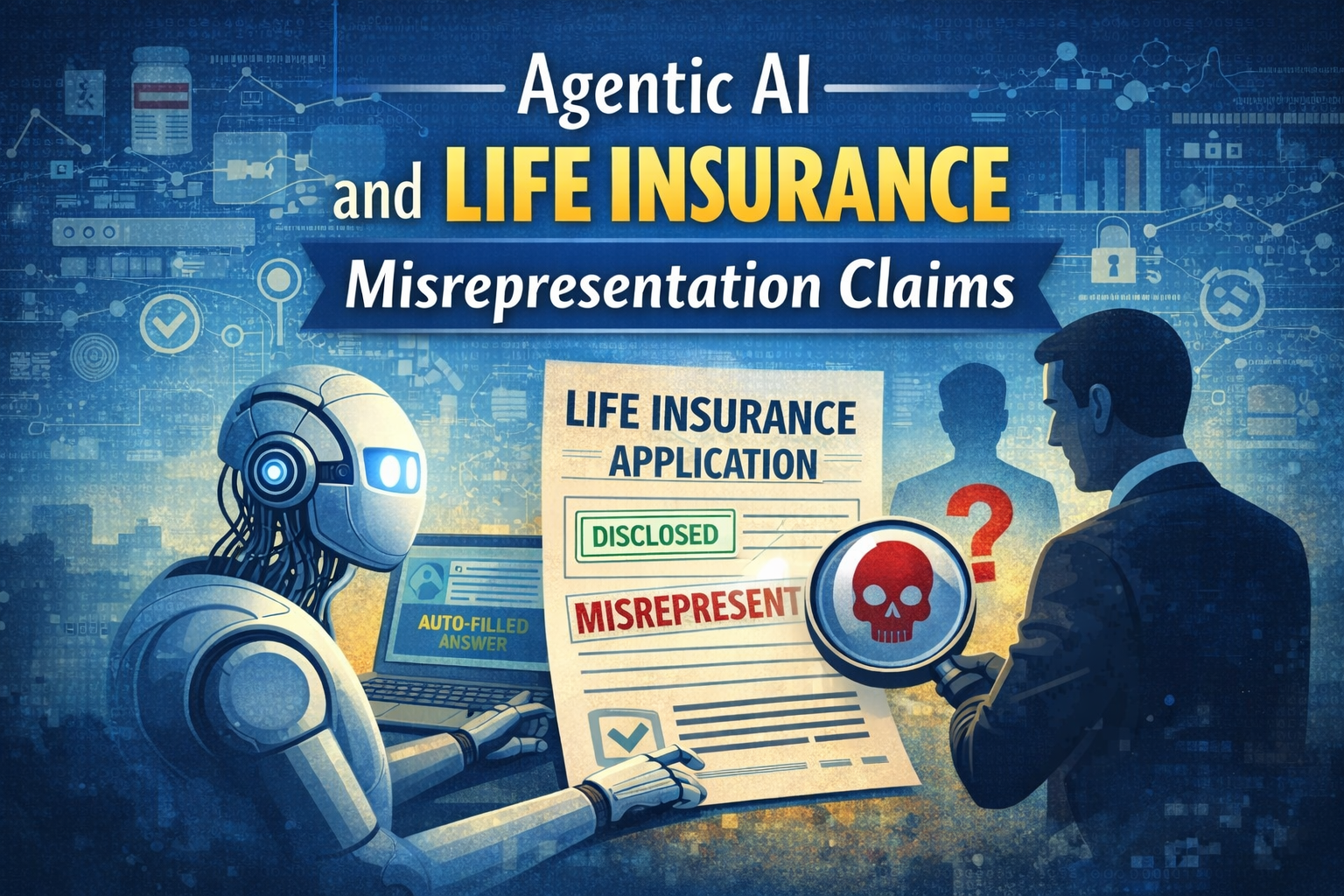
Life insurance companies are beginning to rely on agentic AI systems to assist with underwriting, application review, and policy issuance. These systems do more than analyze data. They actively interpret information, prompt applicants, auto populate answers, and flag disclosures in real time.
As this technology spreads, a serious legal issue is emerging. When an AI agent plays a meaningful role in completing or interpreting a life insurance application, insurers should not be able to later accuse policyholders or beneficiaries of misrepresentation based on how that AI processed information.
Misrepresentation law was built for human interactions. Agentic AI complicates that framework in ways insurers cannot ignore.
What Agentic AI Means in the Life Insurance Application Process
Agentic AI refers to systems that act with a degree of autonomy. In life insurance, this can include chat based application tools, smart questionnaires that adapt based on answers, systems that rephrase questions, or automated agents that guide applicants through disclosures.
Unlike static forms, these systems shape the information that gets recorded. They decide which follow up questions to ask, how to interpret vague answers, and when to move an applicant forward.
In many cases, the applicant is not typing free form responses. They are selecting from prompts, confirmations, or summaries generated by the AI.
How Misrepresentation Claims Traditionally Work
Life insurance misrepresentation claims usually arise during the contestability period. Insurers argue that the insured failed to disclose a medical condition, prescription, habit, or risk factor at the time of application.
To succeed, insurers typically must show that the statement was false, material to the underwriting decision, and made by the insured.
That framework assumes a human applicant answering clear questions on a static form.
Agentic AI disrupts every part of that assumption.
When AI Shapes the Answer, Who Is Responsible
If an AI system rephrases questions, narrows response options, or summarizes prior disclosures, the final answer may reflect the AI’s interpretation rather than the applicant’s intent.
For example, an applicant may disclose a prior condition verbally or through an initial prompt, only to have the AI determine that the condition does not require further disclosure based on internal logic.
Later, after a claim is filed, the insurer may point to the written application and allege misrepresentation, even though the AI agent controlled how the information was captured.
Blaming the insured in that scenario raises serious legal and fairness concerns.
Auto Population and Inferred Answers Create Risk
Some agentic systems auto populate answers based on external data, prior applications, or inferred behavior. Others flag discrepancies and suggest corrected responses.
If an AI fills in or modifies an answer, the applicant may not understand the legal significance of what is being recorded.
Misrepresentation law does not support holding applicants responsible for errors created by the insurer’s own automated systems.
Insurers Cannot Use AI as Both Shield and Sword
Insurers benefit from agentic AI by streamlining underwriting, reducing costs, and increasing policy issuance speed. They cannot then disown the system when it produces inconvenient outcomes.
If an insurer chooses to deploy an AI agent in the application process, that agent acts on the insurer’s behalf. Errors, omissions, and interpretations made by the system should be attributed to the insurer, not the applicant.
Courts have long recognized that insurers bear responsibility for their agents. An AI agent should not be treated differently simply because it is software.
Misrepresentation Claims Become Harder to Prove
As agentic AI becomes more involved, insurers will face higher burdens when asserting misrepresentation.
They may need to show not only what was disclosed, but how the AI presented questions, what prompts were used, and whether the system filtered or deprioritized certain information.
Black box decision making undermines the insurer’s ability to prove intent, clarity, and materiality.
Why Beneficiaries Are Especially Vulnerable
Misrepresentation claims are often raised after the insured has died. Beneficiaries are left defending an application process they did not witness.
When AI was involved, beneficiaries have no way of knowing how questions were asked or how answers were processed unless the insurer is forced to disclose system logs and decision pathways.
Without legal pressure, insurers rarely volunteer that information.
Legal Challenges Ahead
Courts will increasingly be asked to decide whether misrepresentation defenses are valid when AI agents played a central role in application completion.
Key questions will include whether disclosures were reasonably clear, whether applicants had meaningful control over responses, and whether insurers can rely on automated systems while denying responsibility for their outputs.
Regulators may also begin scrutinizing these practices under unfair insurance and consumer protection laws.
What This Means for Policyholders and Beneficiaries
Policyholders should be cautious when interacting with AI driven application systems. Beneficiaries should be skeptical when insurers allege misrepresentation without explaining how the application was generated.
A misrepresentation denial does not automatically mean the insurer is right, especially when agentic AI was involved.
Final Thoughts
Agentic AI is already changing how life insurance applications are completed. As these systems take on greater autonomy, insurers must accept the legal consequences of deploying them.
Misrepresentation law cannot be used to punish consumers for decisions made by machines acting on behalf of insurers. When AI agents shape the contract, insurers own the outcome.
We have recently settled claims from: Western & Southern Financial; Symetra; Protective Life; American National; and Athene life insurance companies.